Gluvy
Gluvy
Gua sha is a technique from traditional Chinese medicine in which a smooth-edged tool is stroked firmly over oiled skin; facial gua sha is a much gentler adaptation used as a relaxing face massage. On the body, gua sha is meant to raise red marks. On the face, it should never hurt or leave marks: you glide a flat stone outward with light pressure for a few minutes. This guide explains where gua sha comes from, how the facial and body versions differ, what the research does and doesn’t show, how to choose a tool, and how to start safely.
If you just want to try it now, go straight to our step-by-step gua sha routine, which walks through the angle, pressure and stroke order for every area of the face.
What is gua sha?
Gua sha is the practice of stroking the skin with a smooth, rounded edge to massage the tissue underneath. In its traditional form it is a body treatment. In its modern beauty form, it is a short self-massage with a flat stone and facial oil.
Two things share the same name, and it helps to keep them apart:
- Traditional (body) gua sha. A practitioner, often an acupuncturist or a practitioner of Chinese medicine, presses a tool firmly over areas like the back, shoulders or neck. The goal is to bring up small red or purple dots on the skin.
- Facial gua sha. You hold a flat stone almost flat against your face and glide it outward in slow, light strokes. The goal is relaxation and a refreshed feeling, never marks.
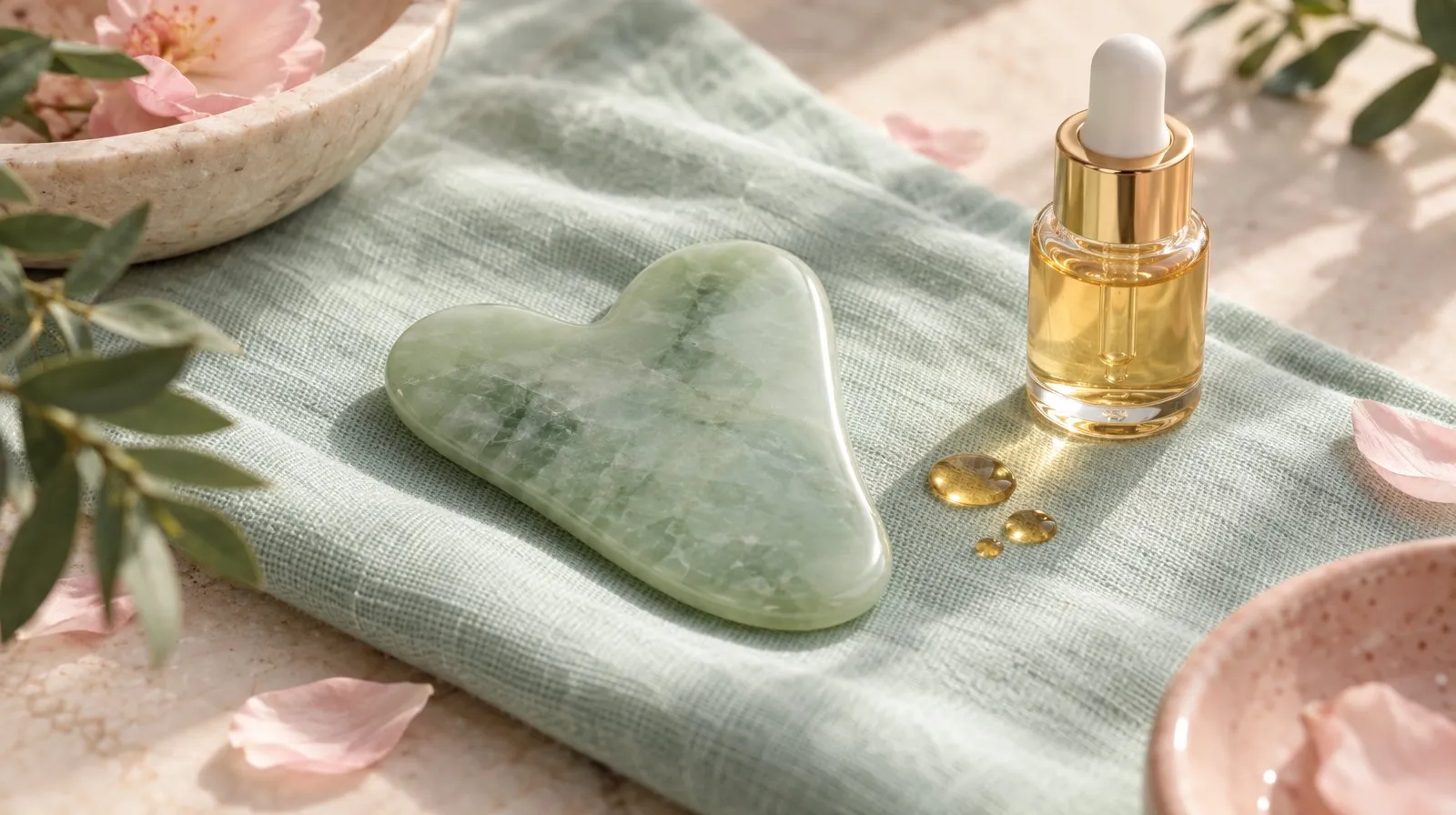
Most people searching for gua sha today mean the second one: the heart-shaped jade or rose quartz stone sold alongside skincare. That is what this hub focuses on, but understanding the original practice explains why facial gua sha is done so differently.
Gua sha meaning and where it comes from
The term gua sha comes from Chinese: “gua” means to scrape, and “sha” refers to the reddish, rash-like marks that appear on the skin after traditional treatment. In English it is often called “scraping therapy.” Traditionally, everyday objects with a smooth edge, such as a ceramic spoon or a coin, were used as the tool.
Gua sha has long been used as a folk and household remedy in China and across East and Southeast Asia, and it is still practised by acupuncturists and practitioners of traditional Chinese medicine today. Traditionally it was used on the body, often for muscle aches, tension and the feeling of being run down.
The traditional explanations are rooted in the concepts of Chinese medicine. Modern researchers have tried to describe what happens in Western physiological terms, but a 2021 review in the Journal of Family Medicine and Primary Care notes that the mechanisms behind gua sha have not been empirically established and that much of the traditional basis comes from repeated observation (Chu et al., 2021).
It’s worth approaching gua sha with respect for that history and without the marketing myths that have grown around it. You’ll see stones sold as “ancient secrets” or with claims about crystal energy. Neither has anything to do with how the practice is used or with what evidence exists. A gua sha stone is a massage tool; its shape and smoothness matter, and its “energy” doesn’t.
Body gua sha vs facial gua sha
Body gua sha uses firm pressure and intentionally causes red marks, while facial gua sha uses light pressure and should leave the skin, at most, a little pink for a few minutes. They share a name and a tool shape, but they differ in almost every practical detail.
| Body gua sha | Facial gua sha | |
|---|---|---|
| Who does it | Usually a trained practitioner | Usually you, at home |
| Where | Back, shoulders, neck, limbs | Face and neck |
| Pressure | Firm | Light to gentle |
| Tool angle | Edge pressed into the skin | Stone held almost flat |
| Marks | Red or purple dots (“sha”) are expected and usually fade over a few days | No marks; a brief pink flush at most |
| Typical aim | Muscle tension and aches | Relaxation, a refreshed look, less morning puffiness |
The marks from body gua sha are called petechiae: tiny spots where small blood vessels near the surface leak a little blood under the skin. A practitioner treats them as an expected part of the session. On your face, they are exactly what you want to avoid. Delicate facial skin bruises easily, and marks on the face mean the pressure or the angle was wrong.
This difference also matters when you read about gua sha research. Most published studies look at body gua sha with firm pressure, performed by a practitioner, for pain. Their results tell you very little about a light, five-minute facial massage at your bathroom sink.
What gua sha may do for your face
Facial gua sha may help your face feel relaxed and look a little less puffy for a while, but there is no good evidence that it changes the shape of your face or slows ageing in the long term. Here is what the research actually covers.
What the studies on body gua sha show
The study most often quoted in gua sha marketing is a 2007 pilot study in the journal Explore. Researchers measured blood flow in the surface tissue of 11 healthy people before and after body gua sha. Blood flow at the treated area rose roughly fourfold for the first 7.5 minutes and stayed raised for the 25 minutes they measured (Nielsen et al., 2007). That is a real but short-lived effect, from firm body gua sha, in a small group with no comparison group. It does not show that gentle facial gua sha does the same, or that any effect lasts.
A 2011 randomised controlled trial in Pain Medicine gave 48 people with chronic neck pain either one gua sha session or a heat pad. The gua sha group reported more pain relief after one week, and the authors concluded that the long-term value was unclear (Braun et al., 2011). Again, that is about neck pain, not your skin or your face.
What the studies on facial gua sha show
Research on facial gua sha itself is thin. One of the few randomised trials, published in 2025 in the Journal of Cosmetic Dermatology, assigned 34 women aged 20 to 50 to use either a gua sha stone or a facial roller for 10 minutes, five times a week, for eight weeks (Ahn et al., 2025). Both groups showed small changes in facial measurements, muscle tone and skin elasticity scores. It is a single small study that compared two massage tools with each other rather than with no massage, so it’s a reason for curiosity, not proof of lasting change. For a closer look at every study, see does gua sha work?.
What that means in practice
Putting it together, here is a fair summary of what facial gua sha may and may not do:
- It may feel relaxing. Slow, repetitive strokes over the face and neck are calming for many people, much like any gentle massage.
- It may help your face look less puffy for a while. Morning puffiness often comes from fluid that settles overnight. Gentle massage, like a cool compress, may make that puffiness look less noticeable for a short time.
- It may help your face feel less tense. If you clench your jaw or frown when you concentrate, a few minutes of massage along the jaw and brows can feel like a release.
- It gives you a calm daily habit. Many people use it as a moment of self-care that pairs well with skincare and face yoga.
- It does not detox your face. Massage doesn’t flush out toxins; your liver and kidneys handle that.
- It is not proven to lift, sculpt or reshape your face. Be wary of before-and-after photos taken minutes apart: a temporary change in puffiness can look like more than it is.
- It is not a substitute for medical or cosmetic treatment. It isn’t comparable to fillers, Botox or surgery, and it doesn’t treat any skin condition.
That doesn’t make gua sha pointless. A habit that feels good, takes five minutes and gives you a calmer start or end to the day is worth having, as long as your expectations match the evidence. We take the same honest approach to face yoga in our guide to whether face yoga works.
Choosing a gua sha tool
For a beginner, the best gua sha tool is a smooth, flat stone with one long curved edge and one notched edge, in whatever material feels comfortable in your hand. The shape matters far more than the stone.
Shapes
- Heart or wing shape. The most versatile shape. The long curved side sweeps the cheeks, neck and forehead, and the notch at the top hugs the jawline. A good first tool.
- Long, flat stone with a wavy or comb edge. The wavy edge is used along the jaw and neck, and the straight edge on broader areas.
- Small, rounded stones. Easier to manoeuvre around the brows, under the eyes and beside the nose.
- Ridged or comb-edged tools. Sometimes used on the scalp or larger areas of the body. Not needed for a facial routine.
Materials
- Jade. The traditional choice. Smooth and relatively affordable. Real jade feels cool to the touch.
- Rose quartz. Very popular in beauty routines. Feels cool and smooth, but chips if dropped.
- Other natural stones (such as amethyst or bian stone). Work the same way; choose them for feel and looks, not for any special property.
- Stainless steel. Durable, easy to clean, doesn’t break when dropped and stays cool. A practical choice if you travel or tend to drop things.
- Ceramic or resin. Lighter and often cheaper. Check that the edges are perfectly smooth.
What to check before you buy
- Smooth, polished edges with no chips, cracks or rough spots that could scratch your skin.
- A comfortable size that sits securely in your hand when your skin and fingers are oily.
- Easy cleaning. Non-porous materials like stainless steel are the simplest to keep clean; natural stone needs gentle care.
- A sensible price. A more expensive stone doesn’t give you better results. Pick one you’ll enjoy using.
Torn between a stone and a roller? Our comparison of gua sha vs jade roller explains how they differ and how to use both. And for shapes, materials and quality checks in detail, see how to choose a gua sha stone.
If you’d like a guided overview, the “Guasha Introduction” article course in the Gluvy app covers what gua sha is, how to choose a stone, basic techniques, a face routine and tips and precautions.
How to do gua sha on your face: a quick overview
A basic facial gua sha session takes 5 to 10 minutes: cleanse, apply oil, hold the stone almost flat and glide it outward in light, single-direction strokes from the neck up to the forehead. Here is the short version; the full step-by-step gua sha routine has the detail for each area.
- Prepare your skin. Cleanse, pat dry and apply a generous layer of facial oil or a slippy serum to your face and neck.
- Start at the neck. Glide gently down the sides of the neck. Many routines begin here before moving to the face.
- Trace the jawline. Use the notched edge along the jaw, from chin toward the ear.
- Sweep the cheeks. Use the long edge from beside the nose outward toward the ear or temple.
- Under the eyes and brows. Use the lightest touch of the session, gliding outward along the bone.
- Forehead and finish. Sweep up toward the hairline, then finish with long strokes from the temples down the neck.
Three to five strokes per area are plenty. Lift the stone at the end of each stroke rather than scrubbing back and forth, and keep the pressure gentle enough that it feels like a massage, never a scrape. Afterwards, wash your stone with warm water and a mild soap and dry it.
If you’re unsure about the angle or the pressure, watching someone do it is the fastest way to learn. That’s why the Gluvy gua sha video courses let you follow along stroke by stroke, with a timer for each step.
Safety: who should skip gua sha or ask first
Facial gua sha is low-risk for most people when it’s done gently, but you should skip it or check with a doctor or dermatologist first in a few situations.
Skip the affected area, or skip gua sha altogether for now, if you have:
- Broken or irritated skin, such as cuts, scratches, sunburn, rashes or a recent peel.
- Active acne breakouts or infected spots. A stone can spread bacteria and aggravate inflamed skin.
- A flare of rosacea, eczema or another inflammatory skin condition.
- Cold sores or any skin infection on the face.
Ask your doctor, dermatologist or the clinician who treated you before you start if you:
- Take blood thinners or bruise easily, or have a bleeding or clotting disorder.
- Have had fillers, Botox or another injectable treatment recently, or any facial surgery or laser treatment.
- Have a skin condition, a condition affecting the blood vessels of your face, or unexplained swelling.
And during any session:
- Stop if it hurts. Facial gua sha should never be painful.
- Ease off if you see marks. Redness that lasts, broken capillaries or bruising mean too much pressure.
- Never press on the eye itself, and keep strokes very light over the front of the throat.
- Don’t share your tool without cleaning it first.
Gua sha is a form of self-care, not a treatment. Our guide to gua sha side effects covers bruising, irritation and who should skip it. For any pain, sudden swelling or change in your skin, see a doctor rather than trying to massage it away.
Gua sha by goal
Most people come to gua sha with one area in mind, and the technique changes slightly for each part of the face. Here’s where to go next, depending on what you’re focusing on.
- The full routine. Start with our gua sha routine for the face: prep, angle, pressure, stroke direction and how often to practise.
- Jawline. The notched edge of the stone fits along the jaw, and many people combine it with simple jawline exercises for the jaw and neck.
- Jowls and the lower face. If you’re mainly thinking about the lower face, our guide to face yoga for jowls explains why jowls form and what a routine can realistically do; gentle gua sha strokes along the jaw fit alongside it.
- Smile lines. Gentle outward strokes beside the nose and across the cheeks are a common part of facial gua sha. For realistic expectations about this area, see our guide to exercises for smile lines.
- Chin and neck. Light downward strokes along the sides of the neck and outward strokes under the chin are part of the routine above. Keep them especially gentle over the throat.
- Brows and forehead. Small strokes along the brow bone and up toward the hairline can feel good if you tend to frown or squint when you concentrate.
- Morning puffiness. A short, cool-stone session in the morning is one of the most popular ways to use gua sha. Expect a temporary, modest difference at most. Our guide on how to debloat your face covers cold, massage and the habits that matter more.
- Choosing an oil. Any facial oil or slippy serum that suits your skin works. If you’re prone to breakouts, a lightweight, non-comedogenic oil is a sensible choice.
We’re adding detailed guides for each area, tool choice, oils and side effects to this hub over time. They’ll appear in the article list below as they’re published.
Gua sha and face yoga together
Face yoga and gua sha complement each other: face yoga actively moves the muscles of your face, while gua sha is a passive massage that relaxes them. Doing both gives you a short routine that combines movement and calm.
| Face yoga | Gua sha | |
|---|---|---|
| What it is | Facial exercises, stretches and hand massage | Gentle massage with a smooth stone |
| Equipment | None, or just your hands | A gua sha stone and facial oil |
| Feels like | A light workout for the face | A slow, calming massage |
| Evidence | Limited; one small study without a control group | Very limited; mostly small or body-focused studies |
The best-known face yoga study, a 2018 pilot in JAMA Dermatology, followed women aged 40 to 65 doing 30 minutes of facial exercises a day for eight weeks and then every other day until week 20. Of the 27 who enrolled, 16 completed it, and dermatologists rated their upper and lower cheeks as fuller in standardised photos (Alam et al., 2018). There was no control group, and larger controlled studies are needed.
A simple way to combine them:
- Do your face yoga moves first, for 5 minutes or so. Our 5-minute face yoga routine for beginners is an easy place to start.
- Apply facial oil.
- Finish with 3 to 5 minutes of gua sha, from the neck up to the forehead.
For the bigger picture on face exercises, read our complete guide to face yoga. If you’re comparing apps that teach both, our roundup of the best face yoga apps looks at what each one includes.
Learn gua sha with Gluvy
Learning the angle, pressure and order of strokes is much easier when you can follow someone doing it. Gluvy’s gua sha video courses include about 34 guided gua sha and facial-massage routines, from jawline, cheek and brow strokes to neck routines and a morning de-puffing massage, each with a timer for every step. You can pair them with more than 200 guided face yoga video exercises, skincare lessons and guided breathing sessions in the same iPhone app. When you’re ready, download Gluvy and start with a 5-minute session.
Sources
- Nielsen A. et al. “The effect of Gua Sha treatment on the microcirculation of surface tissue: a pilot study in healthy subjects.” Explore, 2007. PubMed
- Braun M. et al. “Effectiveness of traditional Chinese ‘gua sha’ therapy in patients with chronic neck pain: a randomized controlled trial.” Pain Medicine, 2011. PubMed
- Chu E.C. et al. “Exploring scraping therapy: Contemporary views on an ancient healing.” Journal of Family Medicine and Primary Care, 2021. PMC
- Ahn et al. “Comparative Effects of Facial Roller and Gua Sha Massage on Facial Contour, Muscle Tone, and Skin Elasticity: Randomized Controlled Trial.” Journal of Cosmetic Dermatology, 2025. PubMed
- Alam M. et al. “Association of Facial Exercise With the Appearance of Aging.” JAMA Dermatology, 2018. doi:10.1001/jamadermatol.2017.5142
Frequently asked questions
What does gua sha do to your face?
Facial gua sha is a gentle massage. Many people find it relaxing, and it may make the face look a little less puffy for a while, especially in the morning. The research on facial gua sha is very limited, so treat it as a pleasant self-care habit rather than a treatment with proven long-term effects.
How often should you do gua sha?
A common starting point is about three short sessions a week of 5 to 10 minutes. If your skin stays calm, you can build up to most days. Gentle and regular is better than long and hard, and you can take a break whenever your skin feels irritated.
Should gua sha hurt or bruise?
Facial gua sha should not hurt or bruise. Traditional body gua sha deliberately raises red marks, but the facial version uses light pressure and a flat stone angle. A soft pink flush that fades within minutes is normal; lasting redness, marks or pain mean you pressed too hard, so stop and go lighter next time.
Is it better to do gua sha in the morning or at night?
Both work, so choose the time you will actually keep. A quick morning session with a cool stone can feel refreshing and may help with morning puffiness. An evening session tends to be slower and more relaxing, which suits a wind-down routine.
Do I need oil for gua sha?
Yes. Facial oil or a slippy serum lets the stone glide instead of dragging on your skin, and dragging is what causes irritation. Use enough that the stone moves smoothly, and add more as soon as it starts to tug.
Is gua sha the same as a jade roller?
No. A jade roller is a small roller on a handle that you roll over the skin, while a gua sha stone is a flat, smooth-edged tool you glide in single strokes, often with a bit more contact. Both are forms of gentle facial massage, and you can use either or both depending on what you enjoy.

Practise this with Gluvy. Follow-along videos with a timer for every step. See Gluvy's gua sha video courses.
Download on theApp Store
The team that builds Gluvy writes these guides from the app's own face yoga, gua sha and skincare courses. We are not doctors or dermatologists: articles are general wellness information, and we link to the research where it exists.
This article is general wellness information, not medical advice. Talk to a doctor or dermatologist if you have a skin, jaw or other medical condition.